Blog Archives

Anne Boleyn’s face?

Unknown woman underneath Elizabeth's portrait

Today I want to discuss about ‘Portraith with a serpent’ that depicts Queen Elizabeth Tudor. Underneath Elizabeth’s face there is a portrait of unknown woman.  She is facing opposite direction and in a higher position than the queen. According to National Portrait Gallery, :

 ”The  X-ray shows a female head  in a higher position, facing in the opposite direction to  the portrait of Elizabeth. The eyes and nose of the face  underneath can now be seen where paint has been lost  from Elizabeth’s forehead. The lips and headdress can also  be seen, as can the ruff which was positioned underneath  Elizabeth’s chin. The identity of the original sitter remains  a mystery but the unfinished portrait appears to have been  very competently painted, probably by a different artist.  The original sitter appears to have been wearing a French  hood of a type that was fashionable in the 1570s and 1580s,  suggesting that there may have been a period of a few years  before the panel was re-used.”

If you look closely, you can notice the similarity between unknown woman and … Anne Boleyn!  The oval face with dark dramatic eyes, high cheekbones and full lips bears resemblance to contemporary accounts on Anne Boleyn’s appearance. This portrait looks very similar to NPG and Hever portraits of Anne Boleyn.

more »

Did Henry VIII father Mary Boleyn’s children?

Henry Carey, Mary's first child

I was inspired to write this article after reading another chapter of new book by David Loades, ‘The Boleyns’. In chapter entitled  ‘Mary & the King’s Fancy – in and out of Favour’ professor Loades states that ;

”Mistress Carey’s charms may have faded, or been replaced by those of her sister, but the indications are that Mary was handed over to her husband at some point in the summer of 1525. Her son, Henry Carey, was born on 4 March 1526, and that suggests that she began to sleep with William at some time in June or July of 1525.” / p. 52 /

”From 1526 onwards Mary is overshadowed by her sister Anne, and glimpses of her in the records become few. She must have spent quite a lot of her time on pregnancy leave, because a few months after Henry’s birth, she had conceived again, and bore William’s second child, a daughter Catherine, at some time in 1527.’ / p. 53/

I have to say that I always thought that Catherine Carey was born c. 1524 and thus was Mary Carey’s first child. In her book ‘Mary Boleyn : The True Story of Henry VIII’s Favourite Mistress’ Josephine Wilkinson states that ;

more »

Mary Boleyn’s portrait…? UPDATE

Copy of 'Mary Boleyn' portrait c. 1630-1670

You probably remember my article about portrait allegedly depicting Mary Boleyn. Historian and author Alison Weir claims that there are 6 versions of this portrait and that it probably depicts a royal sitter because of the ermine fur;

“The fact that there are at least six versions of the ‘Mary’ portrait indicates that there was demand for a portrait of the sitter, and she is wearing ermine, a fur restricted to the upper nobility and royalty.”[1]

I did a research about this and in this article I am going to write more about this portrait. I was looking for information about provenance of the portrait of ‘Mary Boleyn’ and confirmation of Alison Weir’s claim that there were ‘at least 6 versions of this portrait’.

I contacted Anna L. Splender who is a Deputy Head Steward at the Hever Castle. She kindly replied that;

more »

Interview with author Raven A. Nuckols

Book cover

Today I am really delighted to post an exclusive interview with Raven A. Nuckols, author of a historical fiction novel ‘Had the Queen Lived: An Alternative History of Anne Boleyn’. This book has already been released and you can buy on Amazon. I am so excited about this book and I am looking forward to immerse myself into the world of ‘what if…’.

‘Had the Queen Lived: An Alternative History of Anne Boleyn’ is not a novel like any other – author uses her imagination to answer the question what if Anne Boleyn lived? What if she did not die a traitor’s death?  I often wondered – had Anne Boleyn became Henry’s true love? Had she been the most celebrated of his wives? Had the history changed if she lived?

I think many of Anne Boleyn’s fans had asked themselves such questions. Now we all have a chance to read an alternative history of Anne Boleyn by Raven A. Nuckols.  I am so thrilled about this book!

S : Welcome to Queen Anne Boleyn Website! I am so glad to have this opportunity and  ask you few questions about your  historical novel ‘Had the Queen Lived: An Alternative History of Anne Boleyn’. Many readers out there in cyber space may not be familiar with your work. Can you tell them a little about yourself and your background?

R:  I’m Raven A. Nuckols and this is my first book out of a trilogy revolving around how different English history would be had Anne lived and give birth to a son. Two more works will be coming in this series and I’m already enjoying coming up with the storylines for those. I live with my boyfriend and our two cats in the DC area in the US. I majored in Economics in college and had no idea that professional writing would end up becoming my true passion, but it is. more »

24 October 1537 – Death of Queen Jane Seymour

Jane Seymour by Hans Holbein, 1537

On this day in history, 24th October 1537, Queen Jane Seymour died after long and exhausting childbirth. She was the third wife of king Henry VIII, but they were married only for 1 year, 4 months and 24 days. But Jane was Henry’s most beloved wife, because she gave him what he desired since 1509 – a son, a male heir to succeed him in the future – Prince Edward Tudor.

Jane was never described as a great beauty. Chapuys wrote that she was ‘of middle height, and nobody thinks that she has much beauty. Her complexion is so whitish that she may be called rather pale.’ Additionally imperial ambassador noticed that she was ‘not very intelligent, and is said to be rather haughty’.[1] Jane was about 27-28 years old when Henry VIII took an interest in her, so by the standards of her age, she was considered to be an old maid. Chapuys expressed his doubts about Jane’s virginity, but here is no proof to confirm or deny that she lived an unchaste life before she became king’s new love. For some reasons, Henry VIII fell in love with Jane Seymour, neglecting his wife Anne Boleyn. Anne and Jane were so different – Anne was pretty and intelligent, with olive skin and dramatic black eyes while Jane was meek, ‘not very intelligent’ as Chapuys described her and she was pale blonde with not much beauty.

But Jane Seymour managed to maintain king’s interest in her and only 11 days after Anne Boleyn’s execution, Jane stepped into her shoes and became Henry’s third wife and queen.

Pregnancy and delivery

The whole court rejoiced when rumors about queen Jane’s pregnancy, although no official announcement was made. Elizabeth Norton writes how;

‘By late May it was noted that she would soon be appearing in an open-laced gown, signifying her status as a pregnant woman’ [2]

We can only imagine how Jane Seymour felt about her pregnancy. She knew exactly that two of her predecessors had failed to give Henry a male heir. Catherine of Aragon had 6 pregnancies and born only one healthy girl, and Anne Boleyn was pregnant 4 times and also gave birth to only one girl. Jane knew that her position is in danger until she would give Henry a long awaited son.

more »

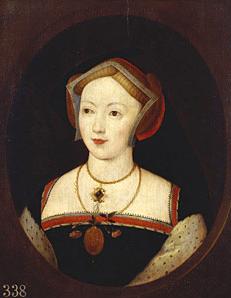
Mary Boleyn’s portrait?

Mary Boleyn...?

In her latest book ‘Mary Boleyn: The Great and Infamous Whore’ Alison Weir points out that the famous portrait of Mary Boleyn may actually be a portrait of Frances Brandon, mother of Jane Grey. On her website, Alison Weir gives an explanation of this theory :

‘I’ve written a whole appendix on the subject of portraits of Mary Boleyn and William Carey. The fact that there are at least six versions of the ‘Mary’ portrait indicates that there was demand for a portrait of the sitter, and she is wearing ermine, a fur restricted to the upper nobility and royalty. So I suspect, given the proliferation of the image, that the sitter was royal. Anyway, the costume is that of the mid-1530s. There would not have been any demand for Mary at that time, given that she was little known and in disgrace (and probably living abroad) from 1534. The sitter bears no resemblance to portraits of Anne Boleyn, Jane Seymour or Margaret Douglas. She is too young to be Mary Tudor, who died in 1533. Could this be Frances Brandon? A wedding portrait from 1533? There is a resemblance in the nose to Charles Brandon in his ‘marriage’ portrait (yes, I think it is him, having done some digging last night, although I think it’s later than 1515/16.) Even so, that doesn’t quite explain the demand for pictures of Frances – she wasn’t that well known either! It would help if we could identify any clue or reference in the pendant or brooch, or the flowers, but they are too indistinct.[1]

For a very long I’ve been thinking about Mary Boleyn portrait, and something was not right. I agree with Alison Weir in few points :

more »

Anne Boleyn : the Rival of Venus?

Detail from Boticelli's 'Birth of Venus'

We can certainly say that Anne Boleyn was not considered beautiful in her times. Typical beauty at Tudor court had blonde hair, pale skin and blue eyes, and Anne had dark complexion, dark hair and enchanting ‘black eyes’. She certainly was not a typical ‘English Rose’ but she was different and interesting. In her book ‘Six Wives of Henry VIII’ Alison Weir states that ;

‘Even King Francis was smitten by the fascinating Anne, and wrote :

Venus était blonde, on m’a dit:

L’on voit bien, qu’elle est brunette.’[1]

‘Venus was blonde, I’ve been told: Now I see that she’s a brunette!’  I was always very curious about this quote, and I never came across the information that Francis I was actually referring to Anne Boleyn.  Dr. Susan Bordo’s recent article made me question this quote once again and I decided to immerse myself into the primary sources and books, to find out whether King Francis was referring to Anne Boleyn when speaking about Venus.

In her book Alison Weir does not cite the reference so it is really hard to get to primary sources. Weir only gives us a hint:

‘For the duration of her stay in France, see Herbert, and also Emmanuel von Meteren’s Histoire des Pays Bas: Crispin, Lord of Milherve’s Metrical History (1618) ; Epistre contenant le process criminal fait a lencontre de la Royne Boullant d’Angleterre by Lancelot de Carles, Clement Marot, and Crispin de Milherve (1545 ; included in La Grande Bretagne devant l’Opinion Francaise by G.Ascoli, Paris, 1927), Histoire de la Royne Anne de Boullant (MS. In the Biblioteque Nationale, Paris, before 1550) ; and Charles de Bourgevilles Les Recherches et Antiquites de la Province de Neustrie’ (1583).’[2]

In her book ‘Anne Boleyn: a young Queen to be’ Josephine Wilkinson states that :

‘In matters of dress her tastes were said to have been adopted by other ladies, although, we are assured, none looked so well as Anne, who was described as the rival of Venus[3]

more »

Myths surrounding Anne Boleyn : a witch?

Myths surrounding Anne Boleyn : a witch?

Modern interpretation of Anne Boleyn by Alexandre Jubran

Anne Boleyn was accused of adultery, incest, treason and plotting to kill a king. But among charges against her, also witchcraft was brought up. Why was Anne accused of witchcraft? Did she had something in common with ‘dark powers’?

In her book ‘The Lady in the Tower : the Fall of Anne Boleyn’ , Alison Weir states that ;

‘At that time witchcraft was not an indictable offence; it was not until 1542 that an act was passed under Henry Viiii making it a secular crime, and it did not become a capital offence until 1563, under Elizabeth I. Prior to that, the penalty for witchcraft had been determined according to evidence of actual criminality, which proof of evil deed being necessary to obtain a conviction; in the cases of persons of high rank, there was often a suspicion of treason against the Crown’.[1]

In England, Scotland and Ireland, between 1542 and 1735 a series of Witchcraft Acts enshrined into law the punishment (often with death, sometimes with incarceration) of individuals practising, or claiming to practice witchcraft and magic. [2] Witchcraft was the alleged use of magical or supernatural powers to harm people or their property. It was also widely believed that witches were in league with Devil. During the times when people did not know how to explain unexplained, they tend to believe in dark powers.

more »

Henry VIII’s gifts for Anne Boleyn

Henry VIII’s gifts for Anne Boleyn


Anne and Henry

Although after Anne Boleyn’s execution Henry VIII did everything to get rid of memories about her, one thing is certain – they were a loving couple for almost 10 years, and Henry was very much in love with Anne. In order to show his feelings towards her, he showered her with magnificent gifts, and some of them are described with details. In this article I will take a closer look on Henry’s gifts for Anne Boleyn.

For many years Anne Boleyn was Henry’s ‘wife-to-be’. Many called her king’s mistress, although she had never accepted such a title, and even refused to sleep with Henry until they were married. It seems that Anne had wrapped Henry around her finger, and he seemed to be madly in love with her. But officially Henry was still married with Catherine of Aragon, and Anne was merely the king’s fancy, or so many people who knew the king believed. So it is natural that Henry wanted to win Anne’s affections by fancy gifts. When the divorce was not going as planned, Henry used to buy Anne magnificent things only to prove to her, that he is going to marry her.

Professor Eric Ives wrote that ‘the couple were always together and Henry’s privy purse expenses show how intertwined their lives were’.[1] Henry’s privy purse accounts have survived for the years 1529-32 and they gives us an insight of the happy time they have spent together as a fiancées.

more »

Anne Boleyn’s badges and mottoes

We know that Anne Boleyn’s heraldic badge was a Falcon, but she had also other badges that she used before she adopted a falcon.

Let’s start with first one :

‘Within this inscription, between ‘je’ and ‘anne’, Anne inserted a small drawing; on close examination this turns out to be an armillary sphere. Evidently this was a device Anne adopted before switching to the falcon on the roses[1]  / Eric Ives, p.240/

What does armillary sphere mean? Professor Ives states that:

more »

  • Archives

    • 2015 (2)
    • 2013 (1)
    • 2012 (13)
    • 2011 (16)
  • Products

    HA Necklace
    39,00€
  • Elizabeth' Rainbow Necklace
    41,58€
  • Anne Boleyn B Necklace
    19,34€